

continued
continued
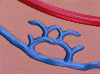 Collagen, however, cannot be
synthesized in the absence of adequate oxygen supply. But the wound
has derailed blood flow. Angiogenesis is required. Through
their enzymatic actions, growth factors break down the vascular
membrane of the venules. Endothelial cells that migrate through the
defect aggregate to form vascular buds (click on image to
download a 98K Quicktime movie).
Collagen, however, cannot be
synthesized in the absence of adequate oxygen supply. But the wound
has derailed blood flow. Angiogenesis is required. Through
their enzymatic actions, growth factors break down the vascular
membrane of the venules. Endothelial cells that migrate through the
defect aggregate to form vascular buds (click on image to
download a 98K Quicktime movie).
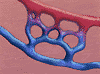 Buds connect with contiguous
buds to form loops. Loops develop a basal membrane from extracellular
matrix components and then develop their own vascular buds. This
process continues until -- Voila! Contact is made with an intact
blood vessel and a capillary loop forms with directed blood
flow (image expandable to 58K GIF).
Buds connect with contiguous
buds to form loops. Loops develop a basal membrane from extracellular
matrix components and then develop their own vascular buds. This
process continues until -- Voila! Contact is made with an intact
blood vessel and a capillary loop forms with directed blood
flow (image expandable to 58K GIF).
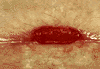 New highly vascularized tissue
has a granular appearance (which may be why it's called granulated
tissue), and is recognizable by its visible pinhead-size rounded
nodules. Nodules that are dark red in color and appear moist and
shiny indicate good healing. Poor healing is indicated by a bluish
color and a smeary fibrin appearance (image expandable to 36K
JPEG).
New highly vascularized tissue
has a granular appearance (which may be why it's called granulated
tissue), and is recognizable by its visible pinhead-size rounded
nodules. Nodules that are dark red in color and appear moist and
shiny indicate good healing. Poor healing is indicated by a bluish
color and a smeary fibrin appearance (image expandable to 36K
JPEG).
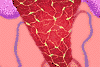 Collagenase, synthesized by
fibroblasts, keeps collagen production in check, and has a critical
function in the process of collagen maturation. Part of the process
of collagen maturation includes developing cross-links, which
give collagen and the scar strength and to reorganize collagen in a
less chaotic way and more along the lines of contour stress.
(Image expandable to 54K JPEG).
Collagenase, synthesized by
fibroblasts, keeps collagen production in check, and has a critical
function in the process of collagen maturation. Part of the process
of collagen maturation includes developing cross-links, which
give collagen and the scar strength and to reorganize collagen in a
less chaotic way and more along the lines of contour stress.
(Image expandable to 54K JPEG).
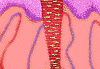 Having formed abundant collagen
fibers, the fibroblasts transform either into fibrocytes or
myofibroblasts, the latter has contractile properties. Consequently
the collagen fibers tighten. The end result of the process? Shrinking
scar tissue! (Image expandable to 36K JPEG).
Having formed abundant collagen
fibers, the fibroblasts transform either into fibrocytes or
myofibroblasts, the latter has contractile properties. Consequently
the collagen fibers tighten. The end result of the process? Shrinking
scar tissue! (Image expandable to 36K JPEG).
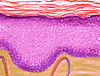 Ah . . .but the wound
surface, you wonder. Repair of the epithelium is needed to
keep the undesirables out and the vital essentials -- body fluids and
electrolytes, for example -- from escaping. (Image expandable to
46K JPEG)
Ah . . .but the wound
surface, you wonder. Repair of the epithelium is needed to
keep the undesirables out and the vital essentials -- body fluids and
electrolytes, for example -- from escaping. (Image expandable to
46K JPEG)
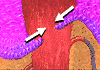 Within 24 hours of wounding, the
basal cell layer of the epidermis adjacent to the wound thickens and
marginal cells elongate and migrate over the wound. The cells
at the advancing epithelial edge are followed by a monolayer of new
epithelial cells that advance across the wound until they eventually
meet epithelial cells moving in from the opposite direction. (Sort of
like the meeting of the transcontinental railroad.) (Click on
image to download Quicktime movie)
Within 24 hours of wounding, the
basal cell layer of the epidermis adjacent to the wound thickens and
marginal cells elongate and migrate over the wound. The cells
at the advancing epithelial edge are followed by a monolayer of new
epithelial cells that advance across the wound until they eventually
meet epithelial cells moving in from the opposite direction. (Sort of
like the meeting of the transcontinental railroad.) (Click on
image to download Quicktime movie)
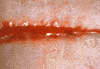 The price of wound repair is a
scar, which appears reddish at first but as the connective
tissue grows tauter and vascularization slows, it gradually looses
color. Hair, sebaceous and sweat glands are also absent, as is the
ridged pattern of the epidermis. Thus the new skin's appearance is
unusually smooth. (Image expandable to 36K JPEG)
The price of wound repair is a
scar, which appears reddish at first but as the connective
tissue grows tauter and vascularization slows, it gradually looses
color. Hair, sebaceous and sweat glands are also absent, as is the
ridged pattern of the epidermis. Thus the new skin's appearance is
unusually smooth. (Image expandable to 36K JPEG)
 Go back to the first page of New Tissue Formation Go back to the first page of New Tissue Formation |
Please see Wound Healing in Specific Tissues 
|
Home | Welcome | Clinical Update | Managing Your Residency | Board Review | Opportunities | Links | Contributors | Contact Us